• Home
  • E-Resources
  • About us
  • Blog
  • Contact us
  • Login
    • Forgot Password
Menu
Click to enlarge
Home ebooks Ludwig’s Applied Process Design for Chemical and Petrochemical Plants

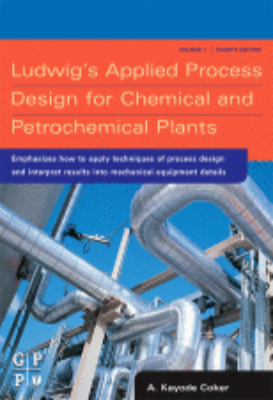
Ludwig’s Applied Process Design for Chemical and Petrochemical Plants

“This complete revision of Applied Process Design for Chemical and Petrochemical Plants, Volume 1 builds upon Ernest E. Ludwigs classic text to further enhance its use as a chemical engineering process design manual of methods and proven fundamentals. This new edition includes important supplemental mechanical and related data, nomographs and charts. Also included within are improved techniques and fundamental methodologies, to guide the engineer in designing process equipment and applying chemical processes to properly detailed equipment.All three volumes of Applied Process Design for Chemical and Petrochemical Plants serve the practicing engineer by providing organized design procedures, details on the equipment suitable for application selection, and charts in readily usable form. Process engineers, designers, and operators will find more chemical petrochemical plant design data in:Volume 2, Third Edition, which covers distillation and packed towers as well as material on azeotropes and ideal/non-ideal systems.Volume 3, Third Edition, which covers heat transfer, refrigeration systems, compression surge drums, and mechanical drivers.A. Kayode Coker, is Chairman of Chemical & Process Engineering Technology department at Jubail Industrial College in Saudi Arabia. Hes both a chartered scientist and a chartered chemical engineer for more than 15 years. and an author of Fortran Programs for Chemical Process Design, Analysis and Simulation, Gulf Publishing Co., and Modeling of Chemical Kinetics and Reactor Design, Butterworth-Heinemann. Key Features. Provides improved design manuals for methods and proven fundamentals of process design with related data and charts. Covers a complete range of basic day-to-day petrochemical operation topics with new material on significant industry changes since 1995.”

Publication Language

English

Publication Access Type

Premium

Publication Author

*

Publisher

Elsevier

Publication Year

*

Publication Type

ebooks

ISBN/ISSN

*

Publication Category

Plant Science

Kindly Login to ICAR Digital Library Portal.

SKU: Elsevier-9780750677660 Category: ebooks Tag: Engineering
Close
Publication Types
  • ebooks 1206
  • eMagazines 2

Related products

Agrarian Development in Peasant Economies

ebooks
Agriculture and Forestry Division, Volume 2: Agrarian Development in Peasant Economies: Some Lessons from Kenya tackles various areas of concerns in agriculture in the context of peasant economy. The title provides examples from the Kenyan agrarian development policies. The text first covers concern in improving agricultural production, and then proceeds to tackling post-war Kenya. Next, the selection talks about Kenyan agrarian revolution, along with the economics and features of peasant agriculture. The sixth chapter discusses government and agrarian development, while the seventh chapter details further problems of agrarian reform. The book will be of great interest to political scientists, economists, agriculturists, and sociologists.

Agricultural Statistics

ebooks
Agricultural Statistics: A Handbook for Developing Countries presents the development of agricultural statistics in various countries of Africa and Asia. This book provides a guideline to those in charge of agricultural statistics in developing countries to know their priorities and to have clear objectives. Organized into 14 chapters, this book begins with an overview of the importance of regular collection of agricultural statistics to the functioning of the community as well as for its agriculture and agricultural development. This text then examines the improvement of methods of collection of existing statistics for greater dependability. Other chapters consider the yield rates and areas of crop production. This book discusses as well the direct estimation of production, which consists of large estates with their processing plants meant for processing their products only. The final chapter deals with the various organizational set-ups for the compilation of agricultural statistics. This book is a valuable resource for agriculturists and statisticians.

Agricultural Sustainability

ebooks
Collaboratively written by top international experts and established scientists in various fields of agricultural research, this book focuses on the state of food production and sustainability; the problems with degradation of valuable sources of land, water, and air and their effects on food crops; the increasing demand of food resources; and the challenges of food security worldwide. The book provides cutting edge scientific tools and methods of research as well as solid background information that is accessible for those who have a strong interest in agricultural research and development and want to learn more on the challenges facing the global agricultural production systems.

Insect Pathology

ebooks
Insect Pathology is designed for a broad spectrum of readers. Is should be useful to students, lecturers, and researchers requiring information about the principles in insect pathology and the biology of pathogens. It should serve as a resource for specialists to learn about other insect pathogen systems, for generalists to become aware of advances in insect pathology, and for scientists and students, beginning or otherwise, interested in learning about insect pathology.. This book was originally intended to update the 1949 test by E. A. Steinhaus entitled Principles of Insect Pathology. The purpose for this book was twofold: To serve (1) as a text for an insect pathology and/or biological control class and (2) as a comprehensive reference source. Because this book summarizes much of the available information, its usefulness as a textbook for an insect pathology class is apparent. Although the literature citations are extensive, they are far from complete. The literature in insect pathology is voluminous and for the past decade has been expanding at an almost exponential rate. A complete review of the literature is beyond the scope of the book, and an omission of a reference does not preclude its importance. Our citations, however, should serve as a good starting point for those who wish to obtain further information. We have attempted to cover equally all subdisciplines, but shortcomings are unavoidable. For these, we take full responsibility.

Postharvest Handling: 1993

ebooks
"Postharvest Handling: A Systems Approach introduces a new concept in the handling of fresh fruits and vegetable. Traditional treatments have been either physiologically based with an emphasis on biological tissue or technologically based with an emphasis on storage and handling. This book integrates all processes from production practices through consumer consumption with an emphasis on understanding market forces and providing fresh product that meets consumer expectations. Postharvest physiologists and technologists across the disciplines of agricultural economics, agricultural engineering, food science and horticulture along with handlers of minially-processed products within the fresh produce fruit and vegetable processing industries will find this to be an invaluable source of information. Key Features

Pulse Foods

ebooks
"Pulses are nutritionally diverse crops that can be successfully utilized as a food ingredient or a base for new product development. They provide a natural food grade ingredient that is rich in lysine, dietary fiber, complex carbohydrates, protein and B-vitamins suggesting that pulses can provide a variety of health benefits such as reducing heart disease and diabetes. Interest in the use of pulses and their ingredients in food formulations is growing and several factors are contributing to this drive. Pulse Foods: Processing, Quality and Nutraceutical Applications is the first book to provide up-to-date information on novel and emerging technologies for the processing of whole pulses, techniques for fractionating pulses into ingredients, their functional and nutritional properties, as well as their potential applications, so that the food industry can use this knowledge to incorporate pulses into new food products. Key Features. First reference bringing together essential information on the processing technology of pulses. Addresses processing challenges relevant to legume and pulse grain processors. Delivers insights into the current state-of-art and emerging processing technologies. In depth coverage of developments in nutraceutical applications of pulse protein and carbohydrate based foods"

Resource Structure of Agriculture

ebooks
Resource Structure of Agriculture: An Economic Analysis focuses on the quantitative economic analysis of the agricultural industry. The book first discusses the theory of resource demand. Topics include decision milieu in agriculture; aggregate demand for an input; and notes on the statistical estimation of the demand function for an input. The text also examines the role of labor in agriculture, including agricultural wages, migration from agriculture, and regional labor supply. The monograph underscores the use of machineries in the agricultural sector. Analysis of post-war demand for power and machinery; early developments in agricultural mechanization; trends in the use of other machinery; and supply conditions for agricultural machinery are discussed. The text also looks at the use of fertilizers and pesticides in the agricultural sector, as well the need to invest in farm buildings. The book examines the demand for resources and supply of agricultural products. Future pattern of resource use and technological change; interactions between demands for different resources; and resource demand and a derived supply elasticity are discussed. The text is a valuable source of data for readers interested in the economic analysis of the agricultural industry.

The Agronomy and Economy of Turmeric and Ginger

ebooks
"Turmeric has been used as a medicine, a condiment, and a dye since at least 600 B.C., while ginger has been used extensively throughout history for its medicinal purposes. The Agronomy and Economy of Turmeric and Ginger brings these two important plants together in one reference book, explaining their history, production techniques, and nutritional and medicinal properties in detail. This book is intuitively organized by plant and use, allowing quick access to information. It puts the uniquely Indian use and history of turmeric and ginger plants into a global context of production and economic aspects. It explores the plants from a botanical perspective, and goes into details of their chemical composition as well. Rounding out the book are chapters on disease and pest control issues. The book is a valuable resource for those involved in the production and marketing of these plants, as well as those looking for more information on the medicinal and nutritional properties of turmeric and ginger. Key Features. The first book to bring together extensive information about turmeric and ginger. Incorporates medicinal, nutritional and agricultural aspects of the two plants. Offers a global perspective"

Tomato Diseases

ebooks
"Following the successful first edition, this revised edition, contains 680 pages and 900 color photos and diagrams, covering every imaginable symptom, pest and disease affecting the tomato. This is the definitive work on the diseases and disorders of the tomato, a worldwide crop of significant economic importance. Key Features. Includes over 300 high quality colour photographs. Explains how to examine and identify diseases of the foliage, roots, neck, stalk and fruit. Enables readers to diagnose and combat both parasitic and non-parasitic diseases of the tomato plant and fruit"

Weather and Agriculture

ebooks
Weather and Agriculture presents the major principles involved in the integrated study of weather and agriculture. The book is divided into three sections. Part I discusses the aspects of environmental factors and their validity and measurement. Part II presents a selection of the weather hazards and their relation to agricultural practice. The last section focuses on productivity, the efficient maximization of available resources towards economic ends. Meteorologists, agriculturists, and pedologists will find the book invaluable.
    Wiley Online Library
    Taylor & Francis Group
    Springer Nature
    Oxford University Press
    Nature.com
    ICAR
    Elsevier

    The Logo depicts wheat in growing stage, the encircling component symbolizes strength of the holistic research.

    • CeRA (Consortium for e-Resources in Agriculture) Agricultural Education Division, ICAR, Krishi Anusandhan Bhavan -II, Pusa, New Nelhi-12
    • Phone: 91-11-25841760
    • Email: adg.ephs@icar.gov.in
    Recent Posts
    • Going Global: International Linkages
      July 11, 2023 No Comments
    • The Network: Disseminating Knowledge
      July 11, 2023 No Comments
    • The Utilization: Waste to Wealth
      July 11, 2023 No Comments
    • Women Power: Contribution at Par
      July 11, 2023 No Comments
    Our Menu
    • Home
    • E-Resources
    • About us
    • Blog
    • Contact us
    E-Resource Categories
    • eJournals
    Subject Categories
    Agricultural Science Animal Science Basic Science Engineering Health Science Life Science
    An Initiative of Indian Council of Agricultural Research (ICAR) Copyright @ 2024. Developed by Informatics Publishing Limited.
    • Menu
    • Categories
    • eJournals
    • Home
    • E-Resources
    • Blog
    • About Us
    • Contact Us
    • Login / Register
    Sidebar
    We use cookies to improve your experience on our website. By browsing this website, you agree to our use of cookies.
    Accept