• Home
  • E-Resources
  • About us
  • Blog
  • Contact us
  • Login
    • Forgot Password
Menu
Click to enlarge
Home ebooks Ludwig’s Applied Process Design for Chemical and Petrochemical Plants

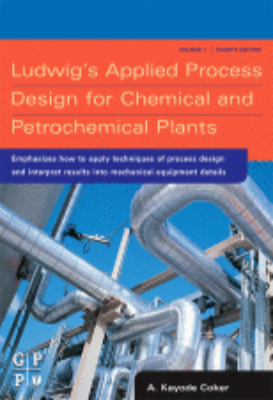
Ludwig’s Applied Process Design for Chemical and Petrochemical Plants

“This complete revision of Applied Process Design for Chemical and Petrochemical Plants, Volume 1 builds upon Ernest E. Ludwigs classic text to further enhance its use as a chemical engineering process design manual of methods and proven fundamentals. This new edition includes important supplemental mechanical and related data, nomographs and charts. Also included within are improved techniques and fundamental methodologies, to guide the engineer in designing process equipment and applying chemical processes to properly detailed equipment.All three volumes of Applied Process Design for Chemical and Petrochemical Plants serve the practicing engineer by providing organized design procedures, details on the equipment suitable for application selection, and charts in readily usable form. Process engineers, designers, and operators will find more chemical petrochemical plant design data in:Volume 2, Third Edition, which covers distillation and packed towers as well as material on azeotropes and ideal/non-ideal systems.Volume 3, Third Edition, which covers heat transfer, refrigeration systems, compression surge drums, and mechanical drivers.A. Kayode Coker, is Chairman of Chemical & Process Engineering Technology department at Jubail Industrial College in Saudi Arabia. Hes both a chartered scientist and a chartered chemical engineer for more than 15 years. and an author of Fortran Programs for Chemical Process Design, Analysis and Simulation, Gulf Publishing Co., and Modeling of Chemical Kinetics and Reactor Design, Butterworth-Heinemann. Key Features. Provides improved design manuals for methods and proven fundamentals of process design with related data and charts. Covers a complete range of basic day-to-day petrochemical operation topics with new material on significant industry changes since 1995.”

Publication Language

English

Publication Access Type

Premium

Publication Author

*

Publisher

Elsevier

Publication Year

*

Publication Type

ebooks

ISBN/ISSN

*

Publication Category

Plant Science

Kindly Login to ICAR Digital Library Portal.

SKU: Elsevier-9780750677660 Category: ebooks Tag: Engineering
Close
Publication Types
  • ebooks 1206
  • eMagazines 2

Related products

A History of Weed Science in the United States

ebooks
"It is important that scientists think about and know their history - where they came from, what they have accomplished, and how these may affect the future. Weed scientists, similar to scientists in many technological disciplines, have not sought historical reflection. The technological world asks for results and for progress. Achievement is important not, in general, the road that leads to achievement. What was new yesterday is routine today, and what is described as revolutionary today may be considered antiquated tomorrow. Weed science has been strongly influenced by technology developed by supporting industries, subsequently employed in research and, ultimately, used by farmers and crop growers. The science has focused on results and progress. Scientists have been--and the majority remain--problem solvers whose solutions have evolved as rapidly as have the new weed problems needing solutions. In a more formal sense, weed scientists have been adherents of the instrumental ideology of modern science. That is an analysis of their work, and their orientation reveals the strong emphasis on practical, useful knowledge; on know how. The opposite, and frequently complementary orientation, that has been missing from weed science is an emphasis on contemplative knowledge; that is, knowing why. This book expands on and analyzes how these orientations have affected weed sciences development. Key Features. The first analytical history of weed science to be written. Compares the development of weed science, entomology and plant pathology. Identifies the primary founders of weed science and describes their role"

Agricultural Statistics

ebooks
Agricultural Statistics: A Handbook for Developing Countries presents the development of agricultural statistics in various countries of Africa and Asia. This book provides a guideline to those in charge of agricultural statistics in developing countries to know their priorities and to have clear objectives. Organized into 14 chapters, this book begins with an overview of the importance of regular collection of agricultural statistics to the functioning of the community as well as for its agriculture and agricultural development. This text then examines the improvement of methods of collection of existing statistics for greater dependability. Other chapters consider the yield rates and areas of crop production. This book discusses as well the direct estimation of production, which consists of large estates with their processing plants meant for processing their products only. The final chapter deals with the various organizational set-ups for the compilation of agricultural statistics. This book is a valuable resource for agriculturists and statisticians.

Agricultural Sustainability

ebooks
Collaboratively written by top international experts and established scientists in various fields of agricultural research, this book focuses on the state of food production and sustainability; the problems with degradation of valuable sources of land, water, and air and their effects on food crops; the increasing demand of food resources; and the challenges of food security worldwide. The book provides cutting edge scientific tools and methods of research as well as solid background information that is accessible for those who have a strong interest in agricultural research and development and want to learn more on the challenges facing the global agricultural production systems.

Insect Pests of Potato

ebooks
"Insect Pests of Potato: Biology and Management provides a comprehensive source of up-to-date scientific information on the biology and management of insects attacking potato crops, with an international and expert cast of contributors providing its contents. This book presents a complete review of the scientific literature from the considerable research effort over the last 15 years, providing the necessary background information to the subject of studying the biology management of insect pests of potatoes, assessment of recent scientific advances, and a list of further readings. This comprehensive review will be of great benefit to a variety of scientists involved in potato research and production, as well as to those facing similar issues in other crop systems. Key Features. Written by top experts in the field, this is the only publication covering the biology, ecology and management of all major potato pests. Emphasizes ecological and evolutionary approaches to pest management. Summarizes information from hard-to-get publications in China, India, and Russia"

Insect Resistance Management: 2014

ebooks
"Neither pest management nor resistance management can occur with only an understanding of pest biology. For years, entomologists have understood, with their use of economic thresholds, that at least a minimal use of economics was necessary for proper integrated pest management. IRM is even more complicated and dependent on understanding and using socioeconomic factors. The new edition of Insect Resistance Management addresses these issues and much more. Many new ideas, facts and case studies have been developed since the previous edition of Insect Resistance Management published. With a new chapter focusing on Resistance Mechanisms Related to Plant-incorporated Toxins and heavily expanded revisions of several existing chapters, this new volume will be an invaluable resource for IRM researchers, practitioners, professors and advanced students. Authors in this edition include professors at major universities, leaders in the chemical and seed industry, evolutionary biologists and active IRM practitioners. This revision also contains more information about IRM outside North America, and a modeling chapter contains a large new section on uncertainty analysis, a subject recently emphasized by the U.S. Environmental Protection Agency. The final chapter contains a section on insecticidal seed treatments. No other book has the breadth of coverage of Insect Resistance Management, 2e. It not only covers molecular to economic issues, but also transgenic crops, seed treatments and other pest management tactics such as crop rotation. Major themes continuing from the first edition include the importance of using IRM in the integrated pest management paradigm, the need to study and account for pest behavior, and the influence of human behavior and decision making in IRM. Key Features. Provides insights from the history of insect resistance management (IRM) to the latest science. Includes contributions from experts on ecological aspects of IRM, molecular and population genetics, economics, and IRM social issues. Offers biochemistry and molecular genetics of insecticides presented with an emphasis on recent research. Encourages scientists and stakeholders to implement and coordinate strategies based on local social conditions"

Integrated Pest Management

ebooks
"Integrated Pest Management: Current Concepts and Ecological Perspective presents an overview of alternative measures to traditional pest management practices using biological control and biotechnology. The removal of some highly effective broad-spectrum chemicals, caused by concerns over environmental health and public safety, has resulted in the development of alternative, reduced risk crop protection products. These products, less toxic to the environment and easily integrated into biological control systems, target specific life stages or pest species. Predation recognized as a suitable, long-term strategy effectively suppresses pests in biotechnological control systems. Integrated Pest Management covers these topics and more. It explores the current ecological approaches in alternative solutions, such as biological control agents, parasites and predators, pathogenic microorganisms, pheromones and natural products as well as ecological approaches for managing invasive pests, rats, suppression of weeds, safety of pollinators, role of taxonomy and remote sensing in IPM and future projections of IPM. This book is a useful resource to entomologists, agronomists, horticulturists, and environmental scientists. Key Features. Fills a gap in the literature by providing critical analysis of different management strategies that have a bearing on agriculture, sustainability and environmental protection. Synthesizes research and practice on integrated pest management. Emphasizes an overview of management strategies, with critical evaluation of each in the larger context of ecologically based pest management"

Managing Agricultural Greenhouse Gases

ebooks
Global climate change is a natural process that currently appears to be strongly influenced by human activities, which increase atmospheric concentrations of greenhouse gases (GHG). Agriculture contributes about 20% of the worlds global radiation forcing from carbon dioxide, methane and nitrous oxide, and produces 50% of the methane and 70% of the nitrous oxide of the human-induced emission. Managing Agricultural Greenhouse Gases synthesizes the wealth of information generated from the GRACEnet (Greenhouse gas Reduction through Agricultural Carbon Enhancement network) effort with contributors from a variety of backgrounds, and reports findings with important international applications.

Molecular Wine Microbiology

ebooks
"Molecular Wine Microbiology features rigorous scientific content written at a level comprehensible for wine professionals as well as advanced students. It includes information on production and spoilage issues, the microbial groups relevant for wine production and microbial wine safety. Microbiology has long been recognized as a key tool in studying wine production, however only recently have wine microbiology studies been addressed at a molecular level, increasing the understanding of how microbiology impacts not only the flavor quality of the wine, but also its safety. Understanding, at a molecular level, how a starter culture can impact ethanol, glycerol, volatile phenols, mannoproteins, biogenic amines or ochratoxin A of a wine are just some of the core points that must be considered in order to achieve maximium consumer acceptability while addressing safety concerns during processing and storage. While other books offer insights into the technological aspects of enology, this book is written by expert microbiologists, who explore the positive and negative impacts of gene function in the production of wine, from a microbiological point of view. Key Features. Winner of the 2012 Jury Award in Enology from the International Organisation of Vine and Wine. Presents the most current methods of studying the microbiology of wine. Includes latest identification and typing methods, reducing identification time from days and weeks to minutes and hours. Provides important knowledge about the impact of microbiological factors at the molecular level for reduction of wine spoilage and increased wine quality and safety"

Postharvest Handling: 1993

ebooks
"Postharvest Handling: A Systems Approach introduces a new concept in the handling of fresh fruits and vegetable. Traditional treatments have been either physiologically based with an emphasis on biological tissue or technologically based with an emphasis on storage and handling. This book integrates all processes from production practices through consumer consumption with an emphasis on understanding market forces and providing fresh product that meets consumer expectations. Postharvest physiologists and technologists across the disciplines of agricultural economics, agricultural engineering, food science and horticulture along with handlers of minially-processed products within the fresh produce fruit and vegetable processing industries will find this to be an invaluable source of information. Key Features

Pulse Foods

ebooks
"Pulses are nutritionally diverse crops that can be successfully utilized as a food ingredient or a base for new product development. They provide a natural food grade ingredient that is rich in lysine, dietary fiber, complex carbohydrates, protein and B-vitamins suggesting that pulses can provide a variety of health benefits such as reducing heart disease and diabetes. Interest in the use of pulses and their ingredients in food formulations is growing and several factors are contributing to this drive. Pulse Foods: Processing, Quality and Nutraceutical Applications is the first book to provide up-to-date information on novel and emerging technologies for the processing of whole pulses, techniques for fractionating pulses into ingredients, their functional and nutritional properties, as well as their potential applications, so that the food industry can use this knowledge to incorporate pulses into new food products. Key Features. First reference bringing together essential information on the processing technology of pulses. Addresses processing challenges relevant to legume and pulse grain processors. Delivers insights into the current state-of-art and emerging processing technologies. In depth coverage of developments in nutraceutical applications of pulse protein and carbohydrate based foods"
    Wiley Online Library
    Taylor & Francis Group
    Springer Nature
    Oxford University Press
    Nature.com
    ICAR
    Elsevier

    The Logo depicts wheat in growing stage, the encircling component symbolizes strength of the holistic research.

    • CeRA (Consortium for e-Resources in Agriculture) Agricultural Education Division, ICAR, Krishi Anusandhan Bhavan -II, Pusa, New Nelhi-12
    • Phone: 91-11-25841760
    • Email: adg.ephs@icar.gov.in
    Recent Posts
    • Going Global: International Linkages
      July 11, 2023 No Comments
    • The Network: Disseminating Knowledge
      July 11, 2023 No Comments
    • The Utilization: Waste to Wealth
      July 11, 2023 No Comments
    • Women Power: Contribution at Par
      July 11, 2023 No Comments
    Our Menu
    • Home
    • E-Resources
    • About us
    • Blog
    • Contact us
    E-Resource Categories
    • eJournals
    Subject Categories
    Agricultural Science Animal Science Basic Science Engineering Health Science Life Science
    An Initiative of Indian Council of Agricultural Research (ICAR) Copyright @ 2024. Developed by Informatics Publishing Limited.
    • Menu
    • Categories
    • eJournals
    • Home
    • E-Resources
    • Blog
    • About Us
    • Contact Us
    • Login / Register
    Sidebar
    We use cookies to improve your experience on our website. By browsing this website, you agree to our use of cookies.
    Accept