• Home
  • E-Resources
  • About us
  • Blog
  • Contact us
  • Login
    • Forgot Password
Menu
Click to enlarge
Home ebooks Jones’s Animal Nursing

Jones’s Animal Nursing

In the tradition of this well established text, the fifth edition is enlarged and updated to cover recent developments in the field of animal nursing. In the four years since the previous edition was published the position of the Veterinary Nurse has become professionally recognized and a new syllabus for the Royal College of Veterinary Surgeons nursing scheme has been established. This has helped define the depth of knowledge required of trainee nurses in their preparation for examinations. In the light of the new syllabus there is a new chapter on Radiography, the chapters on First Aid, Basic Nursing Care, The Practice of Nursing and Surgical Nursing have been extensively revised, and the chapter on Medical Nursing has been lengthened. The contributions, from 27 experts in the field, are highly illustrated and suggestions for further reading are provided at the end of each chapter.

Publication Language

English

Publication Access Type

Premium

Publication Author

*

Publisher

Elsevier

Publication Year

*

Publication Type

ebooks

ISBN/ISSN

*

Publication Category

Animal Science

Kindly Login to ICAR Digital Library Portal.

SKU: Elsevier-9780080361574 Category: ebooks Tag: Health Science
Close
Publication Types
  • ebooks 1206
  • eJournals 828
  • eMagazines 2

Related products

A History of Weed Science in the United States

ebooks
"It is important that scientists think about and know their history - where they came from, what they have accomplished, and how these may affect the future. Weed scientists, similar to scientists in many technological disciplines, have not sought historical reflection. The technological world asks for results and for progress. Achievement is important not, in general, the road that leads to achievement. What was new yesterday is routine today, and what is described as revolutionary today may be considered antiquated tomorrow. Weed science has been strongly influenced by technology developed by supporting industries, subsequently employed in research and, ultimately, used by farmers and crop growers. The science has focused on results and progress. Scientists have been--and the majority remain--problem solvers whose solutions have evolved as rapidly as have the new weed problems needing solutions. In a more formal sense, weed scientists have been adherents of the instrumental ideology of modern science. That is an analysis of their work, and their orientation reveals the strong emphasis on practical, useful knowledge; on know how. The opposite, and frequently complementary orientation, that has been missing from weed science is an emphasis on contemplative knowledge; that is, knowing why. This book expands on and analyzes how these orientations have affected weed sciences development. Key Features. The first analytical history of weed science to be written. Compares the development of weed science, entomology and plant pathology. Identifies the primary founders of weed science and describes their role"

Agrarian Development in Peasant Economies

ebooks
Agriculture and Forestry Division, Volume 2: Agrarian Development in Peasant Economies: Some Lessons from Kenya tackles various areas of concerns in agriculture in the context of peasant economy. The title provides examples from the Kenyan agrarian development policies. The text first covers concern in improving agricultural production, and then proceeds to tackling post-war Kenya. Next, the selection talks about Kenyan agrarian revolution, along with the economics and features of peasant agriculture. The sixth chapter discusses government and agrarian development, while the seventh chapter details further problems of agrarian reform. The book will be of great interest to political scientists, economists, agriculturists, and sociologists.

An Introduction to Economics for Students of Agriculture
ebooks
The Introduction to Economics for Students of Agriculture describes the universal economic principles, illustrated primarily by examples drawn from farming and the food industry. This book is composed of nine chapters, and begins with what an overview of the concepts of economics, its objective, with a particular emphasis on the mechanism of allocating scarce resources. The succeeding chapters deal with the behavior of individual through the theory of consumer choice, the concept of demand and supply, market competitions, and production economics. These topics are followed by discussions on the mobility of the factors of production and unemployment, and some problems of using the market as a resource allocator. This book will prove useful to economists, agriculturists, and students.

An Introduction to Field Quantization

ebooks
An Introduction to Field Quantization is an introductory discussion of field quantization and problems closely related to it. Field quantization establishes a commutation relation of the field and finds an operator in such a manner that the Heisenberg equation of motion is satisfied. This book contains eight chapters and begins with a review of the quantization of the Schroedinger field and the close relation between quantized field theory and the many-body theory in quantum mechanics. These topics are followed by discussions of the quantization of the radiation field and the field of lattice vibrations in a solid. The succeeding chapter deals with the familiar linear equations in relativistic field theory and the deduction of certain spin independent theories, which these fields have in common. Other chapter explores the derivation technique of the conservation laws for fields with arbitrary spin directly from the field equations without explicit recourse to Noether's theorem using a configuration space version of the generalized Ward identity. The discussion then shifts to the relativistic quantization method applicable to any field with arbitrary spin; the transformation of various fields under the Lorentz transformation; and a general method for constructing wave functions explicitly, as well as the application of this method to several examples. The concluding chapter focuses on the quantization of interacting fields. This book will prove useful to physicists and researchers.

Genetically Modified Plants

ebooks
"A transgenic organism is a plant, animal, bacterium, or other living organism that has had a foreign gene added to it by means of genetic engineering. Transgenic plants can arise by natural movement of genes between species, by cross-pollination based hybridization between different plant species (which is a common event in flowering plant evolution), or by laboratory manipulations by artificial insertion of genes from another species. Methods used in traditional breeding that generate transgenic plants by non-recombinant methods are widely familiar to professional plant scientists, and serve important roles in securing a sustainable future for agriculture by protecting crops from pest and helping land and water to be used more efficiently. There is worldwide interest in the biosafety issues related to transgenic crops because of issues such as increased pesticide use, increased crop and weed resistance to pesticides, gene flow to related plant species, negative effects on nontarget organisms, and reduced crop and ecosystem diversity. This book is intended to provide the basic information for a wide range of people involved in the release of transgenic crops. These will include scientists and researchers in the initial stage of developing transgenic products, industrialists, and decision makers. It will be of particular interest to plant scientists taking up biotechnological approaches to agricultural improvement for developing nations. Key Features. Discusses traditional and future technology for genetic modification. Compares conventional non-GM approaches and genetic modification. Presents a risk assessment methodology for GM techniques. Details mitigation techniques for human and environmental effects"

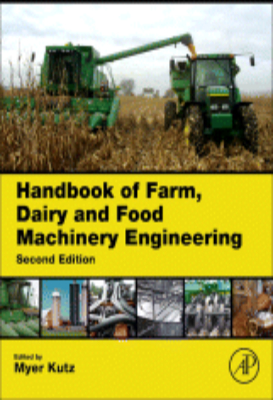
Handbook of Farm, Dairy and Food Machinery Engineering

ebooks
Handbook of Farm, Dairy and Food Machinery Engineering is the essential reference for engineers who need to understand those aspects of the food industry from farm machinery to food storage facilities to the machinery that processes and packages our foods. The process of getting food from "farm to fork," as the saying goes, involves more than planting, harvesting, shipping, processing, packaging and distributingthough those are all key components. Effective and efficient food delivery systems are built around processes that maximize the effort while minimizing cost, time, and resource depletion. This comprehensive reference is for engineers who design and build machinery and processing equipment, shipping containers, and packaging and storage equipment. It includes cutting-edge coverage of microwave vacuum application in grain processing, cacao processing, fruit and vegetable processing, ohmic heating of meat, facility design, closures for glass containers, double seaming, and much more.

Insect Pests of Potato

ebooks
"Insect Pests of Potato: Biology and Management provides a comprehensive source of up-to-date scientific information on the biology and management of insects attacking potato crops, with an international and expert cast of contributors providing its contents. This book presents a complete review of the scientific literature from the considerable research effort over the last 15 years, providing the necessary background information to the subject of studying the biology management of insect pests of potatoes, assessment of recent scientific advances, and a list of further readings. This comprehensive review will be of great benefit to a variety of scientists involved in potato research and production, as well as to those facing similar issues in other crop systems. Key Features. Written by top experts in the field, this is the only publication covering the biology, ecology and management of all major potato pests. Emphasizes ecological and evolutionary approaches to pest management. Summarizes information from hard-to-get publications in China, India, and Russia"

Insect Resistance Management: 2014

ebooks
"Neither pest management nor resistance management can occur with only an understanding of pest biology. For years, entomologists have understood, with their use of economic thresholds, that at least a minimal use of economics was necessary for proper integrated pest management. IRM is even more complicated and dependent on understanding and using socioeconomic factors. The new edition of Insect Resistance Management addresses these issues and much more. Many new ideas, facts and case studies have been developed since the previous edition of Insect Resistance Management published. With a new chapter focusing on Resistance Mechanisms Related to Plant-incorporated Toxins and heavily expanded revisions of several existing chapters, this new volume will be an invaluable resource for IRM researchers, practitioners, professors and advanced students. Authors in this edition include professors at major universities, leaders in the chemical and seed industry, evolutionary biologists and active IRM practitioners. This revision also contains more information about IRM outside North America, and a modeling chapter contains a large new section on uncertainty analysis, a subject recently emphasized by the U.S. Environmental Protection Agency. The final chapter contains a section on insecticidal seed treatments. No other book has the breadth of coverage of Insect Resistance Management, 2e. It not only covers molecular to economic issues, but also transgenic crops, seed treatments and other pest management tactics such as crop rotation. Major themes continuing from the first edition include the importance of using IRM in the integrated pest management paradigm, the need to study and account for pest behavior, and the influence of human behavior and decision making in IRM. Key Features. Provides insights from the history of insect resistance management (IRM) to the latest science. Includes contributions from experts on ecological aspects of IRM, molecular and population genetics, economics, and IRM social issues. Offers biochemistry and molecular genetics of insecticides presented with an emphasis on recent research. Encourages scientists and stakeholders to implement and coordinate strategies based on local social conditions"

The Agronomy and Economy of Important Tree Crops of the Developing World

ebooks
"Major tree crops contribute substantially to the economy of many developing countries on the Asian, African and Latin American continents. For example, coffee is the main revenue earner for Kenya. This book provides a comprehensive review of the agronomy, botany, taxonomy, genetics, chemistry, economics, and future global prospects of a range of crops that have great food, industrial and economic value such as cocoa, coffee, cashew, oil palm and natural rubber. Key Features. Discusses the major tree crops of great economic value to the developing world. The author is an eminent scientist who has won numerous awards for his work in this area"

The Produce Contamination Problem: 2009

ebooks
Understanding the causes and contributing factors leading to outbreaks of food-borne illness associated with contamination of fresh produce continues to be a worldwide challenge for everyone from the growers of fresh-cut produce through the entire production and delivery process. Additionally researchers both at universities and in government agencies are facing an increased challenge to develop means of preventing these foodborne illness occurrences. The premise of this book is that when human pathogen contamination of fresh produce occurs, it is extremely difficult to reduce pathogen levels sufficiently to assure microbiological safety with the currently available technologies. A wiser strategy would be to avoid crop production conditions that result in microbial contamination to start. These critical, problem-oriented chapters have been written by researchers active in the areas of food safety and microbial contamination during production, harvesting, packing and fresh-cut processing of horticultural crops, and were designed to provide methods of contamination avoidance. Coverage includes policy and practices in the US, Mexico and Central America, Europe, and Japan.
    Wiley Online Library
    Taylor & Francis Group
    Springer Nature
    Oxford University Press
    Nature.com
    ICAR
    Elsevier

    The Logo depicts wheat in growing stage, the encircling component symbolizes strength of the holistic research.

    • CeRA (Consortium for e-Resources in Agriculture) Agricultural Education Division, ICAR, Krishi Anusandhan Bhavan -II, Pusa, New Nelhi-12
    • Phone: 91-11-25841760
    • Email: adg.ephs@icar.gov.in
    Recent Posts
    • Going Global: International Linkages
      July 11, 2023 No Comments
    • The Network: Disseminating Knowledge
      July 11, 2023 No Comments
    • The Utilization: Waste to Wealth
      July 11, 2023 No Comments
    • Women Power: Contribution at Par
      July 11, 2023 No Comments
    Our Menu
    • Home
    • E-Resources
    • About us
    • Blog
    • Contact us
    E-Resource Categories
    • eJournals
    Subject Categories
    Agricultural Science Animal Science Basic Science Engineering Health Science Life Science
    An Initiative of Indian Council of Agricultural Research (ICAR) Copyright @ 2024. Developed by Informatics Publishing Limited.
    • Menu
    • Categories
    • eJournals
    • Home
    • E-Resources
    • Blog
    • About Us
    • Contact Us
    • Login / Register
    Sidebar
    We use cookies to improve your experience on our website. By browsing this website, you agree to our use of cookies.
    Accept